The short answer
Hard water is primarily an equipment and operating-cost problem, not automatically a drinking-water health problem.
When calcium and magnesium are present at high enough levels, scale can form on heated surfaces and in small passages. That is why water heaters, heat exchangers, showerheads, faucets, dishwashers and laundry equipment are often where a property notices hardness first.
The strongest evidence is around heated equipment
Controlled Battelle/WQRF testing found material scale effects on water-heating equipment and fixtures under hard-water test conditions. As hardness increased, modeled operating cost increased in the gas-storage test, while tankless equipment exposed to very hard water accumulated scale rapidly during accelerated testing.
The practical point is that hardness, temperature, flow, equipment design and maintenance all affect scale burden. A property with high measured hardness and heavy hot-water use has more reason to evaluate treatment than a low-use property with only modest hardness.
Where scale commonly shows up
- tankless heater heat exchangers;
- electric heating elements;
- faucet aerators and showerheads;
- dishwasher spray passages;
- washing-machine valves and heaters;
- toilet fill valves and small control passages;
- tile and glass exposed to repeated evaporation.
When softening makes sense
A softener becomes more compelling when three things line up: measured hardness is high, the property has substantial water use and expensive equipment is repeatedly exposed to heated hard water.
For lower-use properties with milder hardness, scale control or routine descaling may be enough. For high-use homes, rentals, hotels, laundries or commercial kitchens, true softening deserves a full cost comparison.
What a softener installation looks like
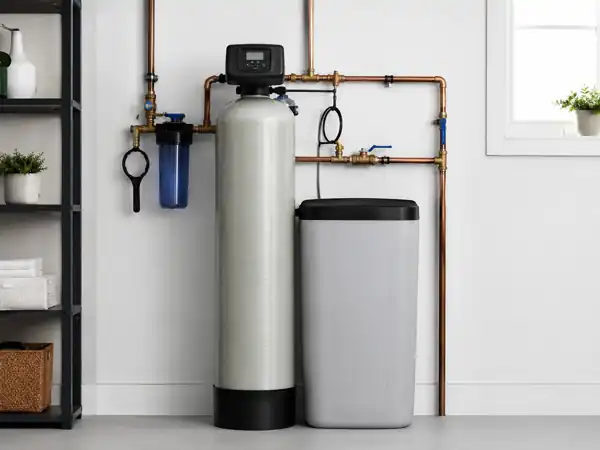
Illustrative equipment layout. Final MirAqua sizing depends on measured hardness, peak flow, regeneration requirements and the equipment being protected.
FAQ
Does hard water destroy appliances immediately?
No. Scale accumulation is gradual and varies with hardness, temperature, flow, equipment design and maintenance.
Is a water softener the same as a sediment filter?
No. A sediment filter removes suspended particles. A softener removes calcium and magnesium hardness ions.
Should I install a softener just because TDS is high?
No. TDS and hardness are different measurements. Measure hardness directly before making a softener decision.