The short answer
A water softener makes sense when a direct hardness test confirms that calcium and magnesium are high enough to create a scale, cleaning or operating-cost problem worth solving.
It does not make sense simply because a TDS meter shows a high number. A conventional ion-exchange softener removes calcium and magnesium hardness, which makes it fundamentally different from a sediment filter, carbon filter, scale-control medium or reverse-osmosis system.
Measure hardness first. Then size the solution around the property.
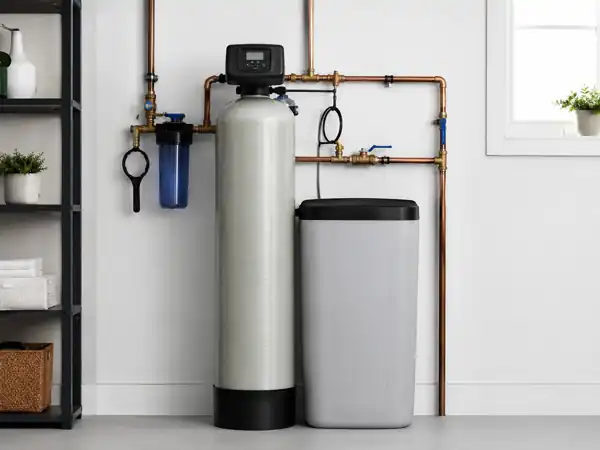
Illustrative softener installation. Final MirAqua pilot configuration may differ by flow, hardness and installation requirements.
What a true water softener does
Ion-exchange softeners pass water through resin that exchanges hardness ions — mainly calcium and magnesium — for sodium or, in some applications, potassium ions.
When correctly sized, regenerated and maintained, the result is water with substantially lower measured hardness. That can reduce scale formation on:
- tankless and storage water heaters;
- heat exchangers and heating elements;
- showerheads and faucets;
- glass and tile;
- valves and small passages;
- dishwashing and laundry equipment.
A softener can also improve how soaps and detergents behave in hard water.
What a softener does not do
A softener is not a complete drinking-water purifier. By itself it does not solve sand or sediment, microbiological contamination, every taste or odor problem, or specific contaminants such as nitrate, arsenic or lead. Those are separate treatment questions.
Why hardness should be measured directly in Cabo
Official groundwater monitoring in Los Cabos documents hard water, but the measured level varies by source and over time.
Verified local records include groundwater hardness measurements around 166 mg/L, 269 mg/L, and historic measurements approaching 477 mg/L as CaCO3 at selected monitoring sites and dates. These are source-water measurements, not a claim about every household tap.
That variability is why the property should be tested directly rather than sized from a neighborhood assumption or TDS reading.
See the verified local hardness examples →
The inputs that actually size the system
A useful softener assessment considers:
- Measured hardness in mg/L as CaCO3 or grains per gallon.
- Average water use — residential or commercial.
- Peak flow rate so the system does not become a bottleneck.
- Equipment being protected, especially high-use hot-water equipment.
- Regeneration efficiency and salt use.
- Drain and installation requirements.
- Maintenance plan and the customer’s tolerance for salt handling/service.
A larger resin tank is not automatically better. Oversizing and poor programming can waste salt and water; undersizing can cause hardness breakthrough or excessive regeneration.
What the appliance evidence supports
Controlled Battelle/WQRF testing provides evidence that hard-water scale can materially affect water-heating equipment and fixtures. Under one specified gas-storage test condition, increasing hardness was associated with increasing modeled operating cost, while tankless equipment exposed to very hard water accumulated scale rapidly enough to require deliming during the accelerated test.
The practical takeaway is simple: hardness, temperature, water use and maintenance all affect scale burden, so the economics are strongest where hard water repeatedly reaches expensive hot-water equipment.
Softener vs scale inhibitor
If the objective is to remove hardness, use a technology that actually removes calcium and magnesium — normally ion exchange.
Polyphosphate, Siliphos and many salt-free systems are better described as scale-control or conditioning technologies when they do not remove hardness ions. They can still be useful in selected applications, but a downstream hardness test may remain essentially unchanged.
Compare softener vs scale inhibitor vs RO →
Softener vs RO
RO can reduce calcium, magnesium and many other dissolved ions in the water stream it treats. That makes it useful for many point-of-use drinking-water objectives.
Whole-house RO is a much larger design problem involving pretreatment, recovery/reject water, storage, boosting, membrane service and possibly post-treatment. If the main documented problem is hardness, a softener is normally the simpler technology to evaluate first.
Where softening can have the most value
The strongest cases are usually properties where hard water touches a lot of expensive equipment or creates repeated cleaning work:
- homes with tankless heaters and heavy hot-water use;
- vacation rentals with frequent turnovers;
- laundries;
- hotels;
- restaurants and commercial kitchens;
- properties with repeated scale-cleaning or descaling costs.
The useful comparison is the property’s actual hardness, water use, equipment exposure, cleaning burden and maintenance cost versus the installed and ongoing cost of softening.
The MirAqua approach
Before sizing a softener, we measure hardness directly, identify the actual scale or equipment problem, estimate water use and peak flow, compare true softening with relevant alternatives, and define the regeneration and maintenance plan.
Frequently asked questions
Do I need a water softener in Cabo?
Only if direct hardness testing and the property’s scale, cleaning or equipment burden justify it. TDS alone is not enough to size or recommend a softener.
Does a water softener make water safe to drink?
No. A softener targets calcium and magnesium hardness. Drinking-water safety may require separate sediment, microbiological or chemical treatment based on testing.
What is the difference between a softener and a scale inhibitor?
A true ion-exchange softener removes hardness ions. Many scale inhibitors or conditioners aim to change deposit behavior without removing calcium and magnesium.
How is a water softener sized?
Sizing depends on measured hardness, water use, peak flow, resin capacity, regeneration strategy, drain requirements and the equipment being protected.