Before choosing a filter, answer one question: what problem are you trying to solve?
Sediment, hardness, taste, microbes and dissolved solids are different problems. They should not automatically receive the same treatment.
For most Los Cabos properties, the best system is a sequence of simple stages, starting with the water entering the property and adding treatment only where measurements or use justify it.
The quick decision guide
| What you notice or want to solve | Start by checking | Treatment to evaluate |
|---|---|---|
| Sand, dirt, rust or visible particles | Sediment / turbidity | Inlet filtration + sediment cartridge |
| White scale, spotting, heater buildup | Direct hardness test | Softener or appropriate scale control |
| Chlorine taste or odor | Free chlorine + taste/odor | Activated carbon |
| Drinking-water dissolved solids | TDS + targeted chemistry | Point-of-use RO |
| Microbiological concern | Appropriate microbial testing | UV, disinfection, RO or a validated treatment train |
| Several problems at once | Full property assessment | Layered system in the correct sequence |
1. Keep sediment out first
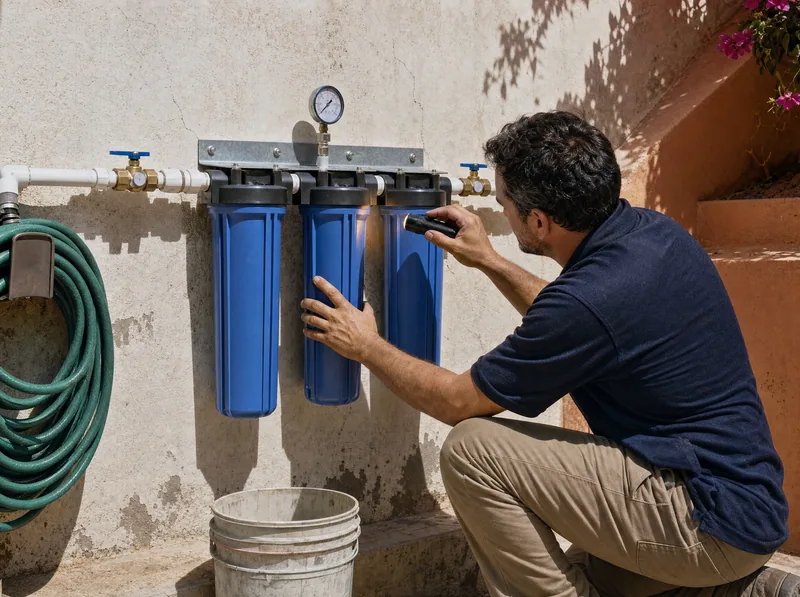
A pipa fill, aging plumbing or a dirty storage tank can introduce suspended material into the system. Capturing larger particles before they circulate through pumps, valves and cartridges is one of the simplest ways to protect everything downstream.
A washable spin-down prefilter is another useful option where the plumbing and flow rate make it appropriate.
Sediment filtration does not soften water and does not by itself make water microbiologically safe. Its job is particle control and equipment protection.
See current MirAqua inlet and sediment filtration options →
2. If the problem is scale, measure hardness
White deposits on shower glass, faucets, heaters and appliances point toward a hardness problem, but the correct measurement is a hardness test, not a TDS reading.
If calcium and magnesium hardness are materially elevated, evaluate ion-exchange softening when the goal is true hardness reduction, scale-control technologies when hardness can remain but scale behavior is the concern, or targeted descaling when treatment is not economically justified.
Illustrative equipment layout; final MirAqua softener configuration depends on measured hardness, flow and installation requirements.
3. Use carbon for the problems carbon actually solves
Activated carbon is useful for selected taste, odor and chlorine objectives. It is commonly used in point-of-use systems and as one stage of a larger treatment train.
Carbon is not a substitute for softening, sediment removal or validated microbiological treatment. The exact cartridge and replacement schedule should depend on water quality, flow, chlorine loading and rated capacity rather than a generic calendar interval.
4. Use RO where low-TDS water is actually needed
Reverse osmosis is particularly useful for drinking and cooking water when the objective is substantial reduction of dissolved ions.
Illustrative under-sink layout. Final MirAqua pilot hardware and configuration may differ.
For many homes, point-of-use RO at the kitchen is more sensible than treating every liter entering the property. Whole-house RO is a larger engineered system involving pretreatment, recovery, reject water, storage and repressurization.
RO should be selected from the measured water chemistry and desired treated-water quality — not simply because a TDS meter displays a large number.
View the MirAqua under-sink RO pilot →
5. Treat microbiological risk as its own question
Clear water can still contain microorganisms. Cloudy water can also interfere with some disinfection technologies.
Depending on the source, storage condition and intended use, microbiological protection can involve source control and clean storage, an appropriate disinfectant strategy, sediment pretreatment, UV in a properly designed flow path, point-of-use membrane treatment, and laboratory verification when required.
Illustrative UV treatment layout. UV performance depends on pretreatment, flow and validated dose.
View the MirAqua whole-house UV pilot →
The sequence matters
A useful Los Cabos treatment sequence is:
Source / delivery → storage → sediment protection → hardness or specialty treatment → drinking-water purification → monitoring and maintenance.
Illustrative whole-house filtration layout; use the product catalog for the actual MirAqua system configuration.
That sequence prevents expensive downstream equipment from doing work that a simpler upstream stage should handle. An RO membrane should not be expected to act as a dirt filter, and a softener should not be expected to disinfect stored water.
View MirAqua Pro 3-stage filtration →
Choose the minimum effective system
Rather than shopping by a fixed budget tier, start with the property’s actual needs:
- Identify how the water arrives and where it is stored.
- Inspect the cistern or tinaco and upstream sediment load.
- Measure hardness, chlorine and TDS separately.
- Add targeted laboratory testing when the use case requires it.
- Select only the treatment stages that solve the documented problems.
- Size the equipment for actual flow and consumption.
- Keep replacement filters, salt, lamps and service requirements visible before buying.
This gives you a system that is easier to maintain and much less likely to be oversized or misapplied.
See the actual products
For current MirAqua photos, specifications and customer pricing, use the product catalog rather than numbers embedded in an article. That keeps the information current when products, configurations or prices change.
View MirAqua filters, purification systems and services →
Build a Cabo-specific water plan →
Frequently asked questions
What is the best water filter for Cabo?
There is no single best filter. The best treatment is the minimum combination that solves the property’s measured sediment, hardness, taste, microbiological or dissolved-solids problems.
Should sediment filtration come before a softener or RO?
In most treatment trains, controlling sediment upstream helps protect more sensitive downstream equipment. Exact sequencing depends on the system and water chemistry.
Can activated carbon soften hard water?
No. Standard activated carbon does not remove calcium and magnesium hardness. A true softener uses ion exchange or another validated hardness-removal process.
Does high TDS mean I need RO?
Not automatically. TDS measures total dissolved material. Decide on RO based on the desired treated-water quality and the specific chemistry you need to reduce.