
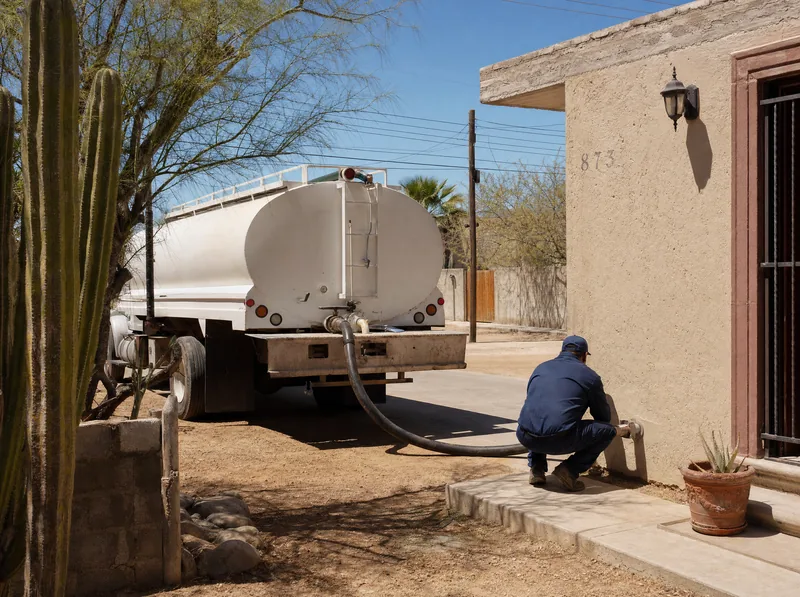
If you live in Los Cabos, you have a relationship with a pipa driver whether you realize it or not. That 10,000-liter tanker truck that backs up to your property every week or two is the most fundamental utility service in your life — more critical than electricity (you can survive without AC for a day; you can’t survive without water), more frequent than any other delivery, and less understood than virtually any service you pay for.
You probably can’t name your pipa company. You don’t know where they fill up. You don’t know what’s in their tank. And yet every drop of water your family bathes in, cooks with, and cleans with came off that truck.
Let’s fix that.
How Pipa Delivery Works
A pipa is a water delivery truck — typically a 10,000-liter stainless steel or plastic tanker mounted on a medium-duty truck chassis. You schedule a delivery (by phone, WhatsApp, or through a service provider), the truck arrives at your property, the driver connects a hose from the truck to your cistern’s fill port, and pumps water in over 15–20 minutes. Standard delivery in Los Cabos costs current price range, expected $650–$1,900 MXN for 10,000L. Most households need a delivery every 10–21 days depending on family size, property type, and cistern capacity. The pipa system is the backbone of Los Cabos water infrastructure — not a backup to municipal supply, but the primary source for the majority of residential properties.
Why Cabo Runs on Pipas
In most cities, you don’t think about where water comes from. It arrives continuously through pressurized pipes, treated and ready. In Los Cabos, municipal supply from OOMSAPAS covers only a portion of the municipality and even where it exists, delivery is often intermittent.
The pipa industry fills the gap. It’s an essential service sector employing thousands of drivers, dispatchers, and operators across the region. During peak tourist season (November through April), pipa demand surges as hotels, resorts, and vacation rentals increase consumption. During the hottest months (June through September), residential demand peaks as families use more water for cooling, gardening, and increased showering.
The pipa isn’t a developing-world workaround. It’s an adapted solution to a genuine infrastructure constraint — a desert city growing faster than its water distribution network. Understanding how the pipa system works puts you in control of one of your household’s most critical services.
Anatomy of a Pipa Delivery
The truck. Most pipas in Los Cabos carry 10,000 liters (10 cubic meters) in a single tank, though smaller 5,000L trucks and larger 20,000L trucks exist. The tank is typically stainless steel or food-grade polyethylene, mounted on a Ford, Chevrolet, or International medium-duty chassis. Reputable operators clean and disinfect their truck tanks regularly. Others… don’t. There’s no mandated inspection schedule for pipa tanks in Los Cabos, which is why source and operator quality matter.
The source. Before the truck arrives at your house, it fills up somewhere. The three main sources are OOMSAPAS municipal filling stations (treated, chlorinated water), private wells (untreated, variable quality), and in some cases other sources of uncertain origin. The source determines the baseline quality of what enters your cistern. An OOMSAPAS fill delivers water that meets NOM-127 treatment standards. A private well fill delivers whatever the aquifer and the well casing provide — which can range from acceptable to significantly mineralized or contaminated.
The connection. The driver connects a 3-inch or 4-inch hose from the truck’s pump to your cistern’s fill port — a pipe opening at ground level, usually near the driveway or at the property boundary. Some fill ports have screw-on caps. Others have simple removable covers. Some have nothing — just an open pipe.
The fill. The truck’s pump pushes 10,000 liters into your cistern in approximately 15–20 minutes. That’s roughly 500–650 liters per minute flowing into a confined underground space. The hydraulic impact is significant — the incoming water column hits the surface of whatever water is already in the cistern, slams into the floor and walls, and creates turbulence that resuspends every gram of sediment that has settled since the last fill. For a few hours after delivery, your tap water may be cloudy. That’s your sediment, redistributed.
The receipt. Professional operators provide a ticket or WhatsApp confirmation showing date, volume, and price. Keep these — they’re your consumption record and expense documentation. If your provider doesn’t give receipts, consider that a yellow flag.
Scheduling: Proactive vs. Reactive
How you schedule pipa delivery has a bigger impact on your water costs and quality than most people realize. There are two approaches, and the difference between them can be 30–50% in annual water spend.
Proactive scheduling means establishing a regular delivery cadence based on your actual consumption. If your household of four uses approximately 10,000 liters every two weeks, you schedule a delivery every 12–13 days — slightly before you’d run out. The pipa comes on your schedule, at standard rates, during normal business hours.
Reactive ordering means waiting until your cistern is nearly empty (or already empty) and calling for a delivery. This creates three problems simultaneously. First, you pay the emergency premium — a same-day or next-day delivery costs emergency premium multiplier, expected 2-3x standard. Update quarterly. times the scheduled rate because the operator needs to reroute a truck to accommodate your urgent request. Second, you may wait hours or even a full day during high-demand periods. Third, every reactive order means you consumed past the optimal buffer level, which means you’re using the oldest, most degraded water at the bottom of the tank.
The emergency premium trap is one of the most expensive patterns in Los Cabos water management. A household that orders reactively four times a year instead of maintaining a schedule can spend annual cost of emergency vs. proactive, expected $2,000-5,000 MXN/year extra. Source: pricing model. Update annually. more per year for the same total water volume.
How to get on a schedule: Track your consumption for two or three delivery cycles. Note the date of each fill and how many days until you need the next one. That’s your cadence. Tell your provider you want a standing order on that cycle. Most reputable operators prefer scheduled customers — it helps them plan routes and capacity.
For households with varying occupancy (vacation rentals, snowbird homes), consumption varies seasonally. Adjust your schedule when occupancy changes rather than defaulting to reactive ordering during busy periods.
Choosing a Pipa Provider
Not all pipa operators are equal, and switching providers is easier than switching almost any other service. Here’s what to evaluate:
Source transparency. A good operator will tell you exactly where they fill — which OOMSAPAS hydrant, which well, which source. Ask directly: “¿De dónde viene el agua?” Operators who source from OOMSAPAS hydrants deliver treated, chlorinated water. Operators sourcing from private wells deliver untreated water of variable quality. Both can be perfectly fine — but you should know which one you’re getting.
Tank condition. Ask when the truck’s tank was last cleaned and disinfected. Professional operators have a maintenance schedule. Owner-operators running a single truck may be less rigorous. A visually rusty or dirty truck exterior doesn’t necessarily mean a dirty tank interior — but it suggests maintenance isn’t a priority.
Reliability. Do they show up on the scheduled day? Do they communicate delays? Can you reach them by phone or WhatsApp? Reliability matters more than the cheapest price because a missed delivery that forces an emergency order from someone else costs far more than the per-delivery savings.
Receipts and documentation. Professionals provide tickets. This protects both of you — it’s proof of delivery, a consumption record, and a tax-deductible expense for property owners and businesses.
Price. Standard 10,000L delivery prices in Los Cabos cluster within a relatively narrow range — standard range, expected $650–$1,900 MXN. Update quarterly.. Significantly cheaper operators may be cutting costs on source quality or tank maintenance. Significantly more expensive operators should be delivering premium service (exact scheduling, treated water, clean trucks, instant receipts). The full pricing breakdown covers what you should expect to pay.
The Hidden Impact of Every Delivery
Each pipa delivery does two things. The obvious one: it adds 10,000 liters of water to your cistern. The hidden one: it disturbs everything that was already in there.
The fill process creates what water engineers call turbulence — the incoming water column hits the resting water surface at speed, then hits the cistern floor. This resuspends the settled sediment layer that has accumulated since the last fill (or since the last cleaning, if you’ve never cleaned it). Fine sediment that had settled harmlessly on the floor gets distributed throughout the water column — which is why your tap water might run cloudy for a few hours after a fill.
This isn’t dangerous in itself, but it illustrates an important dynamic: your cistern isn’t refreshed by a delivery. It’s stirred. The new water mixes with whatever was already there — including the old water, the sediment, and any biofilm fragments dislodged by the turbulence. If the incoming water has chlorine residual and the existing water has none, the residual gets diluted across the total volume, potentially dropping below the effective disinfection threshold of 0.2 mg/L almost immediately.
This is why inlet filtration makes such a disproportionate difference. A filter at the fill port catches the sediment in the incoming water before it enters the cistern — preventing the single largest source of new sediment. It doesn’t stop internal sediment from being resuspended, but it prevents the incoming load from adding to the problem delivery after delivery.
Your Pipa Action Plan
The free fix: Switch from reactive to proactive scheduling today. Call your pipa provider, tell them your delivery frequency, and set up a standing order. Ask where they source their water. Write down their answer. You’ve just eliminated the emergency premium and gained information about your water quality — for zero cost.
The cheap fix (~$350 MXN): Install a sock filter or mesh screen at your cistern inlet before your next delivery. This is a fabric or mesh filter that fits over the fill port opening and catches sediment, debris, and particulates as the pipa pumps water in. Replace it every 2–3 fills (they cost a few pesos each) or buy a reusable stainless mesh version. This single upgrade reduces sediment accumulation by reduction percentage, expected 60-80%. Source: filtration testing. Update when data available. and protects everything downstream.
The right fix ($200–400/year): Establish a relationship with a premium, source-transparent provider on a fixed schedule. Pair this with inlet filtration, annual cistern cleaning, and consumption tracking. The marginal cost over a basic pipa arrangement is modest. The compound benefit — lower sediment, less appliance damage, no emergency premiums, known water source — is substantial.
What Pipa Delivery Actually Costs
The per-delivery price is straightforward: current standard range, expected $650–$1,900 MXN per 10,000L. Update quarterly.. What varies is the annual total, which depends entirely on your consumption, cistern size, and ordering discipline.
A proactive household of four might spend annual cost, expected $8,000-15,000 MXN/year. Source: model. Update annually. on pipa delivery. A reactive household of the same size, ordering emergency deliveries when they run dry, might spend 30–50% more for the same water volume.
The full cost picture — including delivery, the hidden damage tax from sediment and hard water, and equipment wear — is covered in the pipa pricing guide.
Frequently Asked Questions
How do I order a pipa in Cabo? ¿Cómo pido una pipa en Cabo? Phone or WhatsApp — search “pipa de agua Los Cabos” or ask your neighbors who they use. Most neighborhoods have 2–3 operators who service the area. For new arrivals, your landlord, HOA, or property manager can recommend a provider. Some operators have Facebook pages or Google Business listings.
How long does a pipa delivery take? ¿Cuánto tiempo tarda en llenar la pipa? The truck fills your cistern in about 15–20 minutes for a standard 10,000L delivery. However, wait times for the truck to arrive can range from same-day (scheduled deliveries) to 24+ hours (emergency orders during peak demand). During high season or after a hurricane, wait times can extend to several days.
Can I watch the delivery to make sure I get the full 10,000 liters? ¿Puedo ver el llenado para asegurarme de recibir los 10,000 litros completos? Yes, and you should — at least occasionally. Reputable operators have a meter on the truck or can show you the tank level before and after. Some customers measure the level change in their cistern with a dipstick to verify volume. Short-changing on volume is uncommon with established operators but not unheard of with unknown providers.
What if I can’t be home for the delivery? ¿Qué pasa si no estoy en casa para la entrega? Many operators can fill without you present if the cistern inlet is accessible from the street or driveway. Discuss this with your provider — some will ask you to leave the fill port uncapped, others have keys or access arrangements for regular customers. The risk of an unattended fill is that you can’t verify volume or observe the water quality coming off the truck.
My water is cloudy right after a pipa fill. Is that normal? Mi agua sale turbia justo después de la pipa. ¿Es normal? Yes. The 10,000L of incoming water creates significant turbulence in the cistern, resuspending settled sediment. The cloudiness (turbidity) typically clears within 2–6 hours as sediment resettles. If it doesn’t clear within 24 hours, or if the water has color or odor, that’s a different issue — your cistern likely needs cleaning. An inlet filter dramatically reduces post-fill turbidity.
Related Reading
Worried about what’s in the pipa water? The quality varies more than the price: Is Pipa Water Safe?
Want to understand what your pipa should cost? Pricing transparency for better decisions: Pipa Pricing Guide
Ready for the single best upgrade under $25? It goes on your cistern inlet: Inlet Filtration
Curious what every delivery stirs up in your cistern? The cascade of consequences: The Sediment Multiplier
Optimize Your Deliveries
The Pipa Planner estimates daily use, reserve days and delivery volume from your inputs. Use the result to request a current quote and coordinate an order.